

Image credit: SpaceX
The largest and most powerful rocket ever built embarked on its second launch attempt on Nov. 18—an experiment that came to an explosive end but ultimately was hailed as a success. SpaceX’s Starship stayed airborne roughly twice as long as its maiden flight in April, successfully reaching space at an altitude of 90 miles (about 30 miles above the internationally recognized Kármán line that marks the boundary between Earth and the heavens).
Starship was supposed to separate from its first stage rocket booster and continue to its peak altitude before descending back to Earth in a controlled reentry. The mission aimed for a suborbital trajectory of 150 miles above sea level with a controlled soft landing in the Pacific Ocean near the Hawaiian islands. This time around, Starship successfully separated from its booster rocket—a feat that failed during the first flight—and continued soaring toward space at increasing speed. But seconds after separating, the first-stage Super Heavy rocket tumbled out of control and exploded over the Gulf of Mexico. Minutes later, SpaceX lost contact with Starship and activated the spacecraft’s self-destruct mechanism to avoid potential mishaps if it veered off-course.
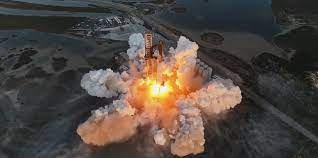
Starship blasts off from Starbase in Boca Chica, Texas on Nov. 18, 2023.
Despite these failures, SpaceX touted several successes where the first test fell short. First, all 33 Raptor engines aboard the Super Heavy first-stage rocket booster consistently fired before separating from Starship about 2.5 minutes after launch. SpaceX engineers have had trouble getting all 33 of the massive engines to consistently fire during ground testing and the first launch attempt fell short of this goal. According to SpaceX, this was a big deal.
The launch also improved upon the previous test by sparing the Starbase launch site in Boca Chica, Texas from total annihilation. During the first test, the launchpad was completely destroyed, sending giant projectiles of concrete and rock in the surrounding area. SpaceX developed a new water deluge system to keep the launchpad intact, which succeeded in dampening Starship’s violent blast using roughly 360,000 gallons of water, according to CNN. The FAA released a statement that no injuries or public property damage had been reported. The agency will conduct a routine investigation before Starship is cleared for a third launch attempt. SpaceX has several new Starships already built and ready once they get the green light for a third launch attempt.
NASA has a significant stake in the success of Starship, having designated the vehicle as the next mode of human transportation to the lunar surface as part of Apollo’s successor program, Artemis. NASA’s Chief Administrator Bill Nelson hailed the test flight via Twitter as “an opportunity to learn—then fly again.” He wrote: “Together NASA and SpaceX will return humanity to the Moon, Mars & beyond.”
NASA has already taken significant steps to invest in Starship by building infrastructure at Kennedy Space Center to accommodate launches once the reusable spacecraft is making regular flights.