
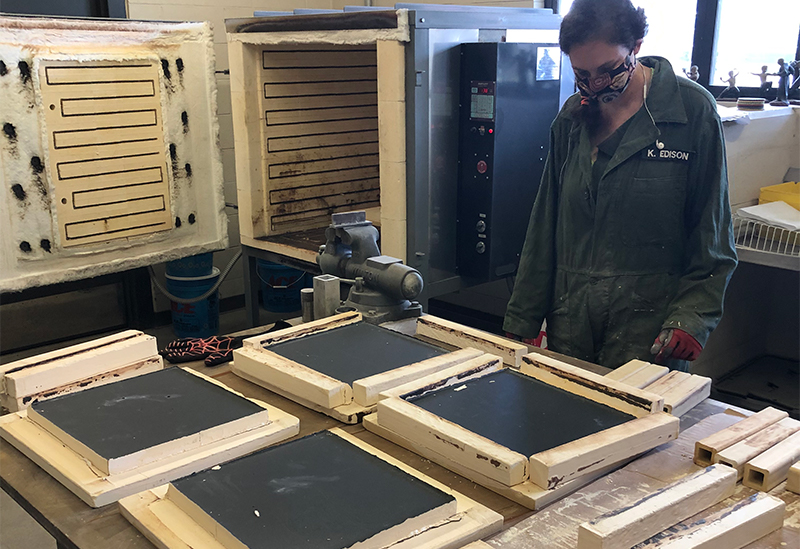
Above: Geology Tech Kyla Edison removes basalt launchpad tiles from their casting molds after sintering.
PISCES completed and shipped a series of sintered basalt tiles last month for testing by NASA’s Swamp Works at Kennedy Space Center. Thirty tiles will be assessed as a launch and landing pad material for both Earth and space applications. The tests will be conducted at Masten Space Systems in Mojave, California.
Earlier this year, Masten tested a 12” x 12” x 1” basalt tile made at PISCES, blasting it with a two-second rocket burst fueled by liquid oxygen and liquid methane. The results caught the interest of Swamp Works, who requested the latest batch of tiles. The next assessment will torch three one-square-meter launch pads (each containing nine tiles) using a dynamic rocket plume mimicking launch and landing conditions. Once the NASA test results are published, PISCES will determine the next steps in developing sintered basalt materials for commercial applications on Earth and beyond.

PISCES began researching basalt-based launchpad tiles in 2014. The Center sent raw Hawaiʻi basalt fines to NASA to be sintered. Between the fall of 2015 and 2016, PISCES created a series of interlocking basalt tiles for the Additive Construction with Mobile Emplacement (ACME) project, which completed a robotically built, full-scale launch pad. The tiles were designed at NASA and sintered by PISCES using Hawaiʻi basalt. After placement by a planetary rover outfitted with a robotic arm provided by Honeybee Robotics, the tiles underwent a static rocket fire test to assess their strength and endurance.
The experience of these previous projects and tests led to refinements and further experimentation to improve the tiles’ durability. Chemical composition of raw basalts is a key factor in producing quality sintered products. Basalt sampled from varying locations can produce significantly different materials after sintering—some better than others. The latest generation of tiles is significantly stronger than those built during the ACME project. PISCES is looking forward to the test results and will continue researching basalt for ISRU applications.